-
-

-
-
-
Mary AbbottCaptain's Neck, c. 1950$ 30,000.00
-
Alice BaberWheel of the Jaguar, 1982$ 25,000.00
-
Janice Biala
Two Young Girls (Hermine & Helen), 1958SOLD
-
Janice BialaVue de la ville: Paris (65 Bd de Clichy), 1949$ 38,000.00
-
Elaine de KooningPeter (Peter Fried), 1956$ 745,000.00
-
Dorothy Dehner
Bayonet, 1981SOLD
-
Dorothy Dehner
Untitled, 1951SOLD -
Perle FineDirection of Time, c. 1950$ 25,000.00
-
Grace HartiganSunbathers, 1966$ 650,000.00
-
Mercedes MatterUntitled (Provincetown), c. 1935$ 150,000.00
-
Joan MitchellComposition, c. 1957$ 2,150,000.00
-
Charlotte Park
Untitled, c. 1955SOLD
-
-
-
Many of her subjects from the late 1940s and early 1950s display the topography and light from her annual winter trips to Haiti and the Virgin Islands. In 1950, she moved to Southampton but maintained a studio in Manhattan. A collaboration between Abbott and Barbara Guest, a first-generation New York School poet, inspired a series of “poetry paintings.” These works combined words and images and were displayed in the exhibition Poetry and Painting alongside work by Frank O’Hara, Kenneth Koch, and Larry Rivers. In 1974, Abbott began teaching at the University of Minnesota, returning to New York in 1980.
[Excerpt from the exhibition catalogue, “Women of Abstract Expressionism” published by Yale University Press in association with the Denver Art Museum]
-
-
Throughout the 1970s, Baber organized exhibitions with the express goal of platforming her fellow women artists, including 1972’s Color Forum at the University of Texas in Austin and Color, Light, and Image at New York City’s Women’s Interart Center. Baber had become active in the Feminist movement and in 1973, worked with Women in the Arts to organize Women Choose Women at the New York Cultural Center.
There has been a recent resurgence of interest in Alice Baber’s work. Within the art market, Baber’s works have garnered un-precedented attention. Berry Campbell held an exhibition of Baber’s work in 2024, marking the first major gallery exhibition of works by Alice Baber in over 40 years. Recently, Dr. Gail Levin published a full scale biography on Alice Baber titled, Alice Baber: An Artist’s Triumph Over Tragedy.
-
-
Biala’s 1930 visit to Paris marked a pivotal moment in her career, where she met novelist Ford Madox Ford, who introduced her to leading modern artists such as Picasso and Matisse. After Ford’s death in 1939, Biala fled Europe, rescuing his manuscripts and her own work as the Nazi threat grew. She returned to New York, married illustrator Daniel Brustlein, and became a key figure in the Abstract Expressionist movement, exhibiting internationally and gaining recognition. In 1947 Biala and Brustlein returned to Europe.
Throughout the 1960s and 1970s, Biala produced some of her largest works, blending painting with collage and focusing on themes like portraiture, landscapes, and Spanish influences. She continued to exhibit globally, with a return to themes of interiors and architectural studies later in her life. Biala’s work was described as intimate and alluring, merging abstraction with figurative concerns. Her obituary in the New York Times praised her as part of a transatlantic tradition alongside Matisse, Bonnard, and others, cementing her legacy as a key figure in modern art.
-
-
Elaine de Kooning is one the most prominent women to reemerge from research into women’s place in Abstract Expressionism. She has been included in Action, Gesture, Paint, Whitechapel Gallery, London (2023); Making Space, Museum of Modern Art, New York (2018); and Women of Abstract Expressionism, Denver Art Museum (2016), among others. She was the subject of a solo exhibition at the National Portrait Gallery, Washington, DC (2015) and was a main character in Ninth Street Women by Mary Gabriel (2017).
Elaine de Kooning is represented in many important private and public collections throughout the country, including the Denver Art Museum; the Metropolitan Museum of Art, New York; the Museum of Modern Art, New York; the National Portrait Gallery, Washington, DC; and the Solomon R. Guggenheim Museum, New York, among many others.
-
-
Dehner's sculpture emphasized contour, rather than mass. In the 1950s, she assembled her works of disparate parts and approached the use of wax as a Constructivist-favoring planar elements. In the 1960s she drew on wax slabs and introduced other textures by adding small pieces of metal. By the mid-1970s Dehner changed her medium from cast metal to wood. The architectonic structure of her wooden ensembles, with thrusting verticals or stacked elements, resemble the skyline of a fanciful city. In the early 1980s Dehner began a new sculpture series of heroic proportions in Cor-Ten and black painted steel.
Recent efforts have situated Dehner in the canon of Abstract Expressionist sculptors alongside Louise Nevelson, Louise Bourgeois, Herbert Ferber, Ibram Lassaw, David Hare, and David Smith. Dehner's totemic sculpture Encounter is currently on view at the Museum of Modern Art, New York. Dehner has been included in four exhibitions at MoMA since 2010, including the seminal, Making Space: Women Artists and Postwar Abstraction (2017). She was the cover article in the Woman's Art Journal (2023).
Her work can be found in the collections of the Metropolitan Museum of Art, New York; the Museum of Modern Art, New York; National Museum of Women in the Arts, Washington, DC; Smithsonian American Art Museum, Washington, DC; Storm King Art Center, New Windsor, New York; and Whitney Museum of American Art, New York, among many others.
-
-
Fine was an active and early member of the American Abstract Artists group. With her dedication to the new Abstract Expressionist style, Fine would continue having success being invited to show with the Betty Parsons Gallery where she had several solo exhibitions. During the 1950s Fine’s work was heralded as unrivaled and on the cutting edge of what was formally becoming The New York School. The early 1950s works had softer edges and an ethereal feel, but by the middle of the 1950s, she was making her most renowned work. These large-scale works were dynamic in feel with a pulsating rhythm between color, gesture and sometimes collage elements, included aluminum foil. Many of these works were shown at Tanager Gallery, the artist cooperative started by Lois Dodd, Alex Katz, and Philip Perlstein.
Fine and her husband moved to the Springs, East Hampton, near their friends Jackson Pollock and Lee Krasner and continued to be central to the artist community on Long Island. Fine was aware of the art world in the 1960s as it shifted to Minimalism, Color Field and Pop Art. For a 1963 solo show at Graham Gallery, she painted colorful reductive paintings called “The Cool Series,” and in the 1970s, started painting in an even more reductive style, “Accordment Series.” Guild Hall Museum in East Hampton did a solo show of these works in 1979.
Since her death, there have been a renewed interest in her place in art history. Perle Fine has been included in a number of important exhibitions including Action, Gesture, Paint, Whitechapel Gallery, London (2023), The Shape of Freedom, Museum Barberini, Potsdam (2022), Labyrinth of Forms, Whitney Museum of American Art, New York (2021-22), Artistic License, Solomon R. Guggenheim Museum, New York (2019-2020), and Women of Abstract Expressionism, Denver Art Museum (2016). She is included in the collections of the Brooklyn Museum, the Metropolitan Museum, the National Gallery of Art, Washington, DC, the Solomon R. Guggenheim, and the Whitney Museum of American Art, among many others.
-
-
Four years later, she left the New York art world behind and moved to Baltimore with her last husband, Dr. Winston Price. She taught art at the Hoffberger School of Painting at the Maryland Institute College of Art and continued to paint for the rest of her life. In 2016, Hartigan was included in the seminal exhibition Women of Abstract Expressionism, curated by Dr. Gwen F. Chanzit and organized by the Denver Art Museum.
-
-
In 1953, Matter began her career as an art educator, teaching at the Philadelphia College of Art, New York University, and Pratt Institute. By 1963, she became disatisfied by arts education and began to hold off-campus drawing class for students who crave studio time, a factor that Matter believed was crucial to an artist’s development. In September 1963, she published “What’s Wrong with U.S. Art Schools?” emphasizing the need for a shift in educational philosophy in order to, “Strip away everything but . . . basic, serious components: drawing, painting, sculpture, history of art.”
In response to this article and call to action, in September 1964, the New York Studio School of Drawing, Painting, and Sculpture opened with Matter as the Founder. The school’s founding manifesto, dedicated to the principle that art education should mirror the life of the artist, was signed by Willem de Kooning, Alexander Calder, Adolph Gottlieb, Barnett Newman, Isamu Noguchi, Mark Rothko, and others.
Matter spent great amounts of time working on drawings and paintings that began as still lifes and gradually evolved into abstraction. In addition to her own art and teaching, she wrote articles about artists such as Hofmann, Franz Kline, and Alberto Giacometti. She also authored the text for a book of her husband’s photographs of Giacometti, published in 1987, four years after his death.
-
-
-
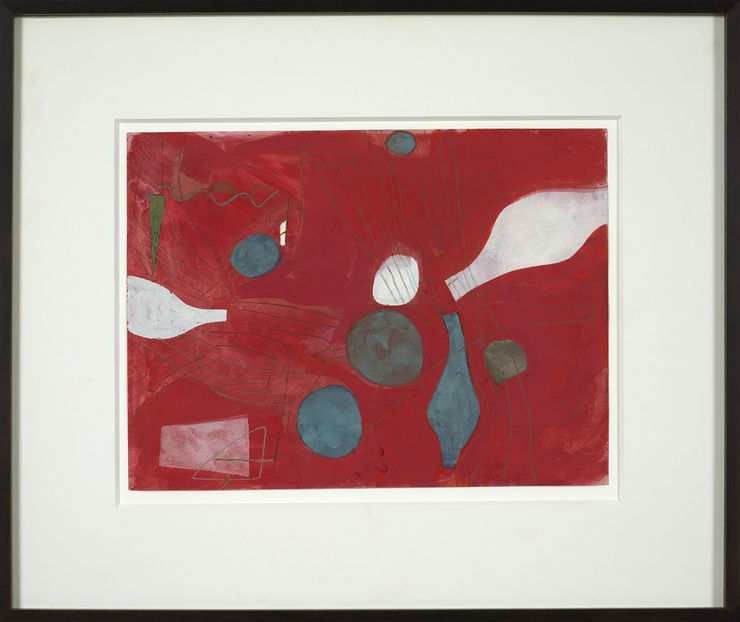
Park initially worked in a monochrome palette, which liberated her to focus on form. By the mid-1950s, she reintroduced color into her art, evolving a lyrical style, in which suggestions of the natural world appeared to pulsate with organic life. By the middle of the decade, she was producing larger canvases with complex compositions and charged relationships of color. She did not shy away from strong contrasts and bold, forthright shapes. Uniting painting and drawing, she formed a vocabulary featuring clustered loops, black curvilinear forms that both define and liberate, and tensed and sensual anatomical suggestions. Figurative elements seem to taunt and loom in her art, but are either suppressed or diffused. In the late 1950s, Park explored collage concurrently with her contemporaries Krasner and Conrad Marca-Relli. For these works, she drew passages of color from her earlier paintings, setting them into new contexts. Later in life, Park was drawn to Piet-Mondrian's Neo-plasticism and created open compositions that conveyed permanence and infinity.
In the 1950s, Park exhibited her work broadly. She participated in her first group exhibition in 1952 at the Peridot Gallery, New York. In 1953, her work was included in the Whitney Museum of American Art's painting annual and at Tanager Gallery's annual exhibition. From 1954 to 1958 she exhibited in the Stable Gallery's annual show, a continuation of the 1951 Ninth Street Show. Her first solo show was at Tanager Gallery in 1957. In deference to her husband, however, she began to withdraw from the art world in the 1960s, a position many women artists took during this time. Charlotte Park did not exhibit her work publicly again until 1973 when a solo show of her art was held at The Elaine Benson Gallery in Bridgehampton, New York. In the twenty years that followed, she was included in numerous exhibitions on Long Island and in New York City. She was also represented in Seventeen Abstract Artists of East Hampton: The Pollock Years, 1946-1956, held in 1979 at the American Cultural Center of the United States Embassy in Paris. In 2003, Park's art was featured, along with that of Dan Christensen and Allan Wexler, in the exhibition, Three East End Artists, held at the Parrish Art Museum, Water Mill. In 2013, the Pollock-Krasner House and Study Center held a solo exhibition of her work. In 2016, her work was featured in the exhibition catalogue for Women of Abstract Expressionism at the Denver Art Museum. Her work was included in Action/Gesture/Paint, which began at the Whitechapel Gallery, London and traveled to the Van Gogh Foundation, Arles, France.
In addition to solo and group shows at Berry Campbell, New York, Park's paintings have been included in a number of museum and gallery exhibitions in recent years, including Setareh Gallery, Düsseldorf, Germany (2018-2019); Columbia Museum of Art, South Carolina (2019); Kasmin Gallery, New York (2019); Art Students League of New York (2019); and Parrish Art Museum, Water Mill, New York (2021), among many others. Park's work is included in the collections of American University, Washington, D.C.; Columbia Museum of Art, South Carolina; Guild Hall, East Hampton, New York; Parrish Art Museum, Water Mill, New York; Whitney Museum of American Art, New York; Telfair Museums, Savannah, Georgia; and Yale University Art Gallery, New Haven, Connecticut.
-
-
Alongside her visual practice, Schloss was also a writer and critic. After working at ARTnews during the 1950s, she served as Art Editor of the International Herald Tribune in Italy from 1968 to 1986 and later contributed regularly to Wanted in Rome. Her work has been the subject of monographic exhibitions at the Klingspor Museum, Offenbach; the Keats-Shelley House, Rome; and Centro Arte Moderna e Contemporanea della Spezia (CAMeC), among others. Schloss’s work is held in public collections including The Metropolitan Museum of Art, New York; the Keats-Shelley House, Rome; Museum Wiesbaden, Wiesbaden, Germany; and the Stadtmuseum Offenbach, Germany.
-
-
In recent years, Schwabacher’s work has been included in a number of museum exhibitions, including Abstract Expressionists: The Women (traveling 2025-2028), Action, Gesture, Paint: Women Artists and Global Abstraction 1940-70, Whitechapel Gallery, London (2023) and Women of Abstract Expressionism, Denver Art Museum (2016-2017). In 2023 and 2025, Berry Campbell hosted major solo exhibitions of her work.
Schwabacher’s works belong to numerous museum collections including the Brooklyn Museum, New York; the Denver Art Museum, Colorado; the Jewish Museum, New York; the Los Angeles County Museum of Art, California; the Metropolitan Museum of Art, New York; the Philadelphia Museum of Art, Pennsylvania; San Francisco Museum of Modern Art, California; Solomon R. Guggenheim Museum, New York; and the Whitney Museum of American Art, New York, among many others.
-
-
In recent years, Yvonne Thomas has been reviewed and written about in publications such as the New York Times (2019) and Artnet News (2022). Her work was recently included in Action, Gesture, Paint, Whitechapel Gallery, London (2023); Women and Abstraction, Addison Gallery, Andover, Massachusetts (2023); and Shatter: Color Field and the Women of Abstract Expressionism, Art Intelligence Global, Hong Kong (2022). Thomas was featured as the cover article in the Woman’s Art Journal (2020).