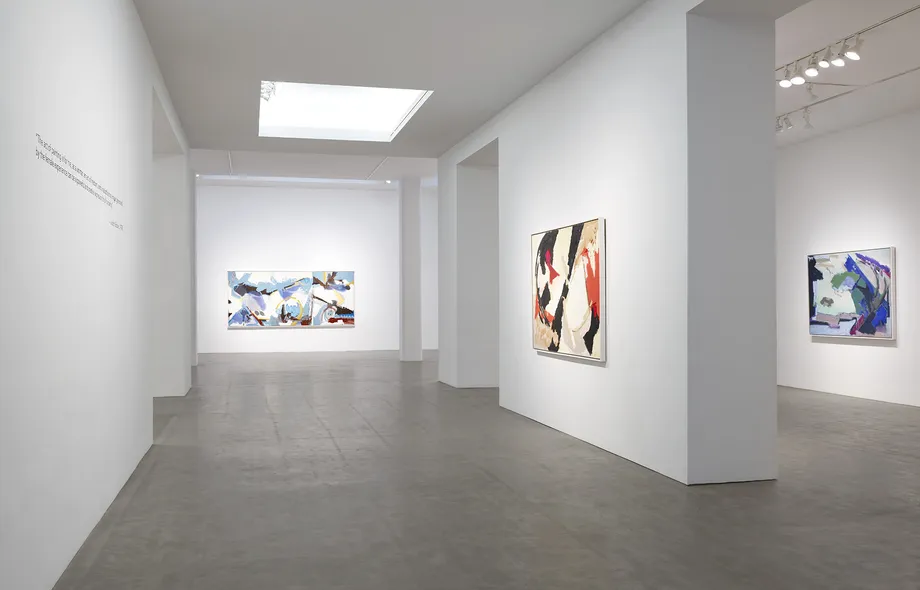
Berry Campbell Gallery is pleased to present Flux and Form, an exhibition dedicated to the work of Abstract Expressionist Judith Godwin (1930–2021), a leading figure of the New York School. This is the gallery’s fourth exhibition of Judith Godwin’s work. Highlighting Godwin’s paintings and works on paper from the late 1970s to the 1990s, it marks the first time in decades that a show has been exclusively focused on the artist’s expressive, physically charged works from this period, with many making their public debut. Featuring over twenty works, the exhibition traces the pivotal influences that underscored Godwin’s distinctive visual language across these three decades, informed by her lifelong passion for modern dance and her friendship with Martha Graham, as well as a profound engagement with the natural environment.
Godwin developed a singular practice over the course of her nearly seven-decade career, marked by sweeping gesture, tonal intensity, and a deeply physical engagement with the act of painting. During her time as a student at Mary Baldwin College in 1950, Godwin invited pioneering choreographer and dancer Martha Graham to campus to perform. Their meeting led to a lifelong friendship that influenced the entirety of the artist’s oeuvre, including her works from the 1970s to the 1990s, translating the expressive force and movement of modern dance into paint, employing rhythm, tension, and embodied motion throughout her compositions. In works like Green Dance (1985), Feathered Arrow (c. 1978), and Grey Wind (1992), Godwin populates works with crescent shapes and squat strokes that imply balletic arabesque and rhythm. Godwin pronounced in 1975 that it was “movement in dance that was the important thing to me, and I thought of it in relation to my painting.”
In 1964, Godwin left New York City with her partner, Anne Barclay, for Connecticut, where she rehabilitated a studio, restored their 18th-century farmhouse, and trained as a landscape gardener. Despite a string of successes, such as several exhibitions at Betty Parsons’s Section Eleven Gallery, she had grown disenchanted with the art world’s adherence to trend. When she returned to the city in the mid-1970s, the experience had transformed her practice. The physicality of gardening and the “weight” of nature entered her work, along with the incorporation of architectural elements. Her work from this period recalls seascapes or landscapes but maintains a gestural freedom, owing to the influence of modern dance, without ever succumbing to representation. Examples representative of this era to be featured in the exhibition include Peacock (1979), Red Knight (1978), and Untitled (c. 1976).
Godwin’s work has been recognized with numerous awards and honors, including an Honorary Doctor of Fine Arts from Virginia Commonwealth University. Along with eleven other women, such as Lee Krasner, Joan Mitchell, Elaine de Kooning, and Helen Frankenthaler, Godwin was included in the defining exhibition, Women of Abstract Expressionism, at the Denver Museum in 2016. Her works were on view in Action, Gesture, Paint, Women Artists and Global Abstraction (1940-70) at the Whitechapel Gallery, London. Currently, her work is included in Abstract Expressionists: The Women, at the Muscarelle Museum of Art and will be touring five additional museums in the United States through 2027. She will also have a solo exhibition at the Muscarelle Museum of Art at the end of this year. Her work is held in numerous institutional collections, including the Art Institute of Chicago, Illinois; the Hirshhorn Museum and Sculpture Garden, Washington, D.C.; the Metropolitan Museum of Art, New York; the Museum of Modern Art, New York; the National Gallery of Art, Washington, D.C.; the San Francisco Museum of Modern Art, California; and the Yale University Art Gallery, New Haven, Connecticut.
